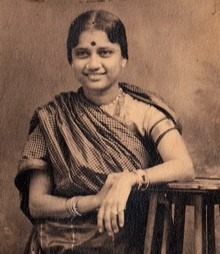
Figure 1.1: Studio promotional portrait of S. D. Subbulakshmi (c. late 1930s), produced during the era of the Madras United Artists Corporation (MUAC), founded by Subbulakshmi and K. Subrahmanyam
1. Polymorphous Engagement: Beyond the Narrative of Passivity
In the Hereditary Histories archive, we reject the paternalistic reading that reduces artists from hereditary communities to “victims” or “passive figures” in the face of twentieth-century media transformations.As historical evidence demonstrates, S. D. Subbulakshmi embodies a model of polymorphous engagement: an extraordinary technical and strategic capacity to navigate across diverse performance formats and media spaces during the formative years of the new Tamil public sphere:
Popular theatre (icai nāṭakam and special nāṭakam);
Oral tradition and devotional storytelling (Harikathā / Kathākālakṣepam);
Early talking cinema (where she emerged as one of the first major box-office stars);
Teaching and institutional leadership (the Natana Kala Seva troupe and the Nrithyodaya dance school).
Subbulakshmi was neither “discovered” nor emancipated by cinema or through her encounters with urban elites. When she stepped onto the film set in 1934, she already possessed immense artistic capital and financial autonomy cultivated through nearly a decade of professional stage experience.
2. Matrifocality and Professional Training: Un-domesticated Lineages
Born in Srivaikuntam in 1917, Subbulakshmi’s artistic lineage challenges the notion that performance excellence originated solely within the upper-caste bourgeois revival movement of the 1930s. Hers was a matrifocal lineage of matrilineal transmission:
Her mother, Janaki Ammal, was a professional dancer from the hereditary community.
Her maternal grandmother, Muttulakshmi Ammal, was among the earliest women to excel in the art of Harikathā.
Her formal training in dance and music was imparted by the famed naṭṭuvaṉār S. Swaminatha Pillai (who had also trained her mother).
Her professional determination was evident from early childhood. At just eight years old, she rejected the theater director Kannaiya’s offer to become his “adopted daughter,” insisting instead on being hired as an independent actress. From the special nāṭakams of Madurai—the most competitive and meritocratic theatrical circuit of the era, where artists were hired individually based on market demand—to her tours in Ceylon and her celebrated stage partnership with M. K. Thyagaraja Bhagavathar (MKT) in the phenomenon Pavaḷakkoṭi, Subbulakshmi established herself as a seasoned stage professional long before Tamil sound cinema took shape.
3. Transition to the Screen: Pavalakkodi (1934) and Reconfigured Patronage
When producer Lena Chettiar and former lawyer K. Subrahmanyam decided to adapt Pavaḷakkoṭi for the screen in 1934, Subbulakshmi entered the film industry as an established star.Her civil marriage in 1935 to Subrahmanyam (who was already married to a Brahmin child bride) and the establishment of their production house, MUAC (Madras United Arts Corporation), represent a critical historical juncture. This union as a “second wife,” though formalized under modern civil law, functionally reproduced the historic dynamics of inter-caste patronage and concubinage between Brahmin men and women from hereditary communities.Through MUAC, Subbulakshmi not only starred in foundational early Tamil films (Bhakta Kuchela, Balayogini, Seva Sadanam), but also directly sustained the logistics and production framework of an emerging film industry.
4. Erased Labor: Nrithyodaya Leadership and the Dance Drama
One of the most vital counter-archival contributions regarding Subbulakshmi concerns her direct role in the restructuring of dance during the 1940s—a domain from which mainstream historiography almost entirely erases her:
Pioneer of the Dance Drama: With her troupe Natana Kala Seva, Subbulakshmi staged the choreographed ballet Pārijātāpaharaṇam in 1942, performing the male role of Lord Krishna herself. Subbulakshmi’s decision to portray Krishna herself introduced a groundbreaking cross-gender dynamic to the modern dance drama, showcasing her exceptional versatility and central artistic direction.
Removal from Nrithyodaya: In 1942, the free dance school Nrithyodaya was founded in Madras. Critical archival records routinely suppressed by modern institutional histories reveal that Subbulakshmi managed and operationally directed the school for its first two years (1942–1944). Today, the institution is celebrated as an upper-caste bastion of “pure” classical dance, while the administrative and pedagogical leadership of the hereditary woman who built its foundations has been erased from official memory.
5. Mechanisms of Stigma: The Trap of “Respectability”
By the 1950s, as upper-caste women entered cinema and dance in large numbers, Subbulakshmi was progressively pushed to the margins, returning to popular theater and Harikathā performances until her death in 1987.Subbulakshmi’s career trajectory underscores the discursive violence of the post-reform period:
Conditional Acceptance through “Sanitization”: Period media praised her by explicitly noting that in her “one does not see the usual traits attributed to a woman from the film world, but instead the refined qualities of a woman from a good family (uyar kuṭumpa strī)”. Her presence was tolerated only on the condition that she masked her community origins and conformed to bourgeois morality.
Familial and Institutional Revisionism: In contemporary family and institutional narratives, Subbulakshmi’s identity is often tokenized to support the myth of a “caste-free” golden era, or her labor is minimized to foreground the reformist legacy of her Brahmin husband.
Key Takeaways for Hereditary Histories
Centering S. D. Subbulakshmi within our digital archive accomplishes three vital political and historiographical goals:
Dismantling the “Director-Savior” Myth: Subbulakshmi possessed an autonomous artistic, musical, and performance legacy inherited through her maternal line, preceding any engagement with urban elite directors.
Exposing Institutional Expropriation: Documenting that early “reformed” dance institutions (such as Nrithyodaya) were built and sustained by the material and pedagogical labor of hereditary women before their presence was systematically purged.
Reclaiming Eclecticism as Resistance: Demonstrating that her fluidity across Harikathā, theater, cinema, and dance was not professional fragmentation, but a sophisticated strategy of survival and artistic expression by a master performer.
Primary Bibliographic Reference:
Hari Krishnan, Celluloid Classicism: Early Tamil Cinema and the Making of Modern Bharatanāṭyam, Middletown, Connecticut, Wesleyan University Press, 2019 (specifically Chapter 1, “The Trope of the Devadāsī: Vernacular Literature, Tamil Drama, and Early Film as Intertextual Media,” pp. 43–58).

