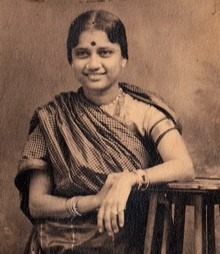
S. D. Subbulakshmi: The Erased Body of Tamil Modernity

Figure 1.1: Studio promotional portrait of S. D. Subbulakshmi (c. late 1930s), produced during the era of the Madras United Artists Corporation (MUAC), founded by Subbulakshmi and K. Subrahmanyam

1. Polymorphous Engagement: Beyond the Narrative of Passivity

In the Hereditary Histories archive, we reject the paternalistic reading that reduces artists from hereditary communities to “victims” or “passive figures” in the face of twentieth-century media transformations.As historical evidence demonstrates, S. D. Subbulakshmi embodies a model of polymorphous engagement: an extraordinary technical and strategic capacity to navigate across diverse performance formats and media spaces during the formative years of the new Tamil public sphere:

Popular theatre (icai nāṭakam and special nāṭakam);

Oral tradition and devotional storytelling (Harikathā / Kathākālakṣepam);

Early talking cinema (where she emerged as one of the first major box-office stars);

Teaching and institutional leadership (the Natana Kala Seva troupe and the Nrithyodaya dance school).

Subbulakshmi was neither “discovered” nor emancipated by cinema or through her encounters with urban elites. When she stepped onto the film set in 1934, she already possessed immense artistic capital and financial autonomy cultivated through nearly a decade of professional stage experience.

2. Matrifocality and Professional Training: Un-domesticated Lineages

Born in Srivaikuntam in 1917, Subbulakshmi’s artistic lineage challenges the notion that performance excellence originated solely within the upper-caste bourgeois revival movement of the 1930s. Hers was a matrifocal lineage of matrilineal transmission:

Her mother, Janaki Ammal, was a professional dancer from the hereditary community.

Her maternal grandmother, Muttulakshmi Ammal, was among the earliest women to excel in the art of Harikathā.

Her formal training in dance and music was imparted by the famed naṭṭuvaṉār S. Swaminatha Pillai (who had also trained her mother).

Her professional determination was evident from early childhood. At just eight years old, she rejected the theater director Kannaiya’s offer to become his “adopted daughter,” insisting instead on being hired as an independent actress. From the special nāṭakams of Madurai—the most competitive and meritocratic theatrical circuit of the era, where artists were hired individually based on market demand—to her tours in Ceylon and her celebrated stage partnership with M. K. Thyagaraja Bhagavathar (MKT) in the phenomenon Pavaḷakkoṭi, Subbulakshmi established herself as a seasoned stage professional long before Tamil sound cinema took shape.

3. Transition to the Screen: Pavalakkodi (1934) and Reconfigured Patronage

When producer Lena Chettiar and former lawyer K. Subrahmanyam decided to adapt Pavaḷakkoṭi for the screen in 1934, Subbulakshmi entered the film industry as an established star.Her civil marriage in 1935 to Subrahmanyam (who was already married to a Brahmin child bride) and the establishment of their production house, MUAC (Madras United Arts Corporation), represent a critical historical juncture. This union as a “second wife,” though formalized under modern civil law, functionally reproduced the historic dynamics of inter-caste patronage and concubinage between Brahmin men and women from hereditary communities.Through MUAC, Subbulakshmi not only starred in foundational early Tamil films (Bhakta Kuchela, Balayogini, Seva Sadanam), but also directly sustained the logistics and production framework of an emerging film industry.

4. Erased Labor: Nrithyodaya Leadership and the Dance Drama

One of the most vital counter-archival contributions regarding Subbulakshmi concerns her direct role in the restructuring of dance during the 1940s—a domain from which mainstream historiography almost entirely erases her:

Pioneer of the Dance Drama: With her troupe Natana Kala Seva, Subbulakshmi staged the choreographed ballet Pārijātāpaharaṇam in 1942, performing the male role of Lord Krishna herself. Subbulakshmi’s decision to portray Krishna herself introduced a groundbreaking cross-gender dynamic to the modern dance drama, showcasing her exceptional versatility and central artistic direction.

Removal from Nrithyodaya: In 1942, the free dance school Nrithyodaya was founded in Madras. Critical archival records routinely suppressed by modern institutional histories reveal that Subbulakshmi managed and operationally directed the school for its first two years (1942–1944). Today, the institution is celebrated as an upper-caste bastion of “pure” classical dance, while the administrative and pedagogical leadership of the hereditary woman who built its foundations has been erased from official memory.

5. Mechanisms of Stigma: The Trap of “Respectability”

By the 1950s, as upper-caste women entered cinema and dance in large numbers, Subbulakshmi was progressively pushed to the margins, returning to popular theater and Harikathā performances until her death in 1987.Subbulakshmi’s career trajectory underscores the discursive violence of the post-reform period:

Conditional Acceptance through “Sanitization”: Period media praised her by explicitly noting that in her “one does not see the usual traits attributed to a woman from the film world, but instead the refined qualities of a woman from a good family (uyar kuṭumpa strī)”. Her presence was tolerated only on the condition that she masked her community origins and conformed to bourgeois morality.

Familial and Institutional Revisionism: In contemporary family and institutional narratives, Subbulakshmi’s identity is often tokenized to support the myth of a “caste-free” golden era, or her labor is minimized to foreground the reformist legacy of her Brahmin husband.

Key Takeaways for Hereditary Histories

Centering S. D. Subbulakshmi within our digital archive accomplishes three vital political and historiographical goals:

Dismantling the “Director-Savior” Myth: Subbulakshmi possessed an autonomous artistic, musical, and performance legacy inherited through her maternal line, preceding any engagement with urban elite directors.

Exposing Institutional Expropriation: Documenting that early “reformed” dance institutions (such as Nrithyodaya) were built and sustained by the material and pedagogical labor of hereditary women before their presence was systematically purged.

Reclaiming Eclecticism as Resistance: Demonstrating that her fluidity across Harikathā, theater, cinema, and dance was not professional fragmentation, but a sophisticated strategy of survival and artistic expression by a master performer.

Primary Bibliographic Reference:
Hari Krishnan, Celluloid Classicism: Early Tamil Cinema and the Making of Modern Bharatanāṭyam, Middletown, Connecticut, Wesleyan University Press, 2019 (specifically Chapter 1, “The Trope of the Devadāsī: Vernacular Literature, Tamil Drama, and Early Film as Intertextual Media,” pp. 43–58).
Jatti Thayamma and the Ideological Distortions of Revisionist Historiography

I. Introduction: The Case of Jatti Thayamma and Caste Revisionism

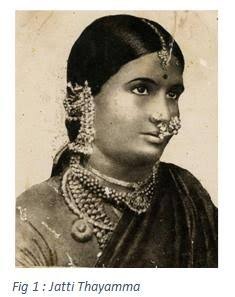
In contemporary historiography dedicated to the performing arts of South India, the historical figure of Jatti Thayamma (1857–1947), a pillar and icon of the Mysore Bani of Bharatanatyam, occupies a position of unquestionable prestige. In recent years, however, her biography and social identity have become the chosen ground for a precise operation of historiographical rewriting by a specific current of research. This trend aims to uproot the illustrious dancer and teacher from her actual historical and communitarian context in order to forcibly insert her into a narrative of “élitist purity” and belonging to the priestly caste.

The underlying ideological objective of this operation is evident: to backdate the practice and preservation of Bharatanatyam to the upper classes (specifically, the Brahmin caste) as early as the 19th century. In doing so, it attempts to defuse and refute the complex historical debate regarding the cultural appropriation of Bharathanatyam suffered by the traditional hereditary communities  during the revivalism and moral “cleansing” of the 20th century.

This essay aims to demonstrate that the recent narrative labeling Jatti Thayamma as a “Brahmin woman” does not rest on solid scientific ground or objective archival evidence. Instead, it is built upon a fragile methodological house of cards characterized by arbitrary iconographic manipulations, distorted sociological interpretations, and an opportunistic utilization of colonial sources.

II. The Iconographic Illusion: The Fabrication of a Visual Identity

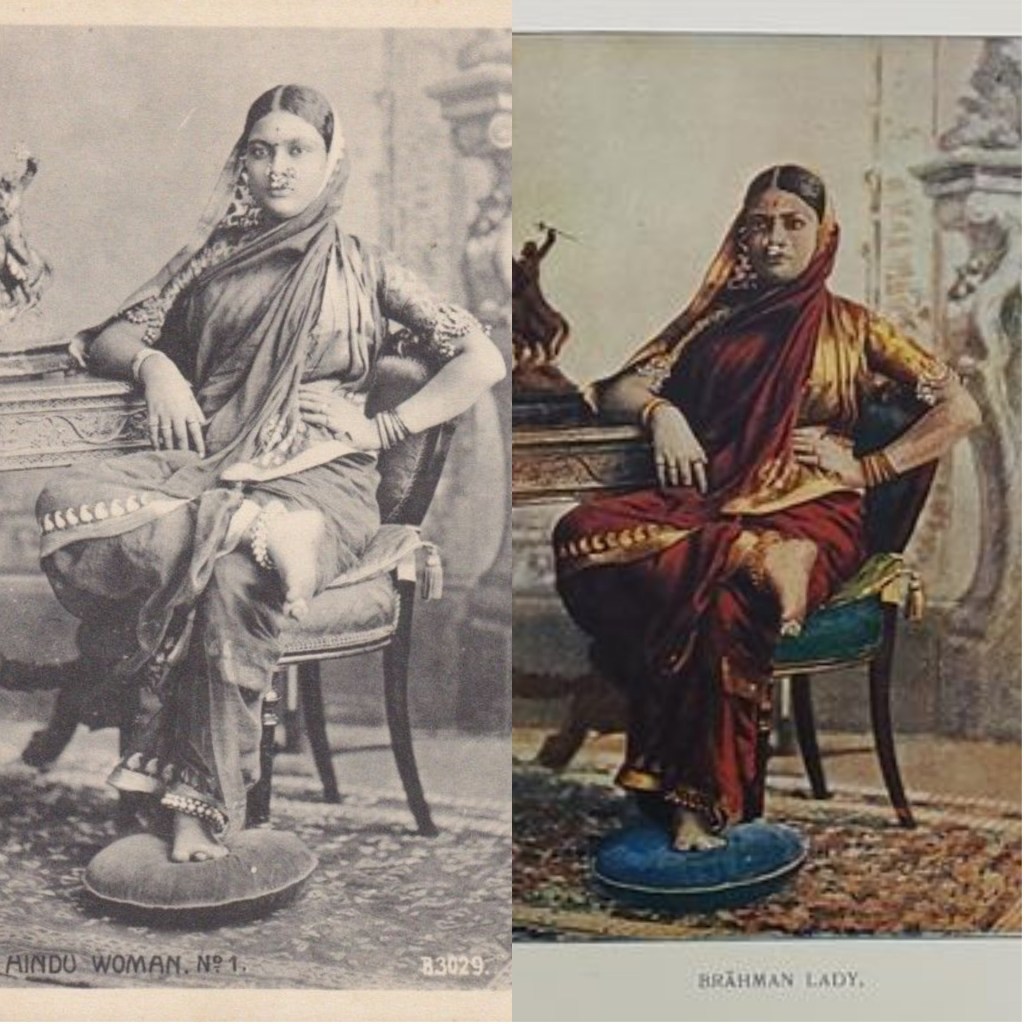
The visual pillar supporting this revisionist operation is a comparative framework that links three distinct images, which are otherwise devoid of any certified historical correlation.

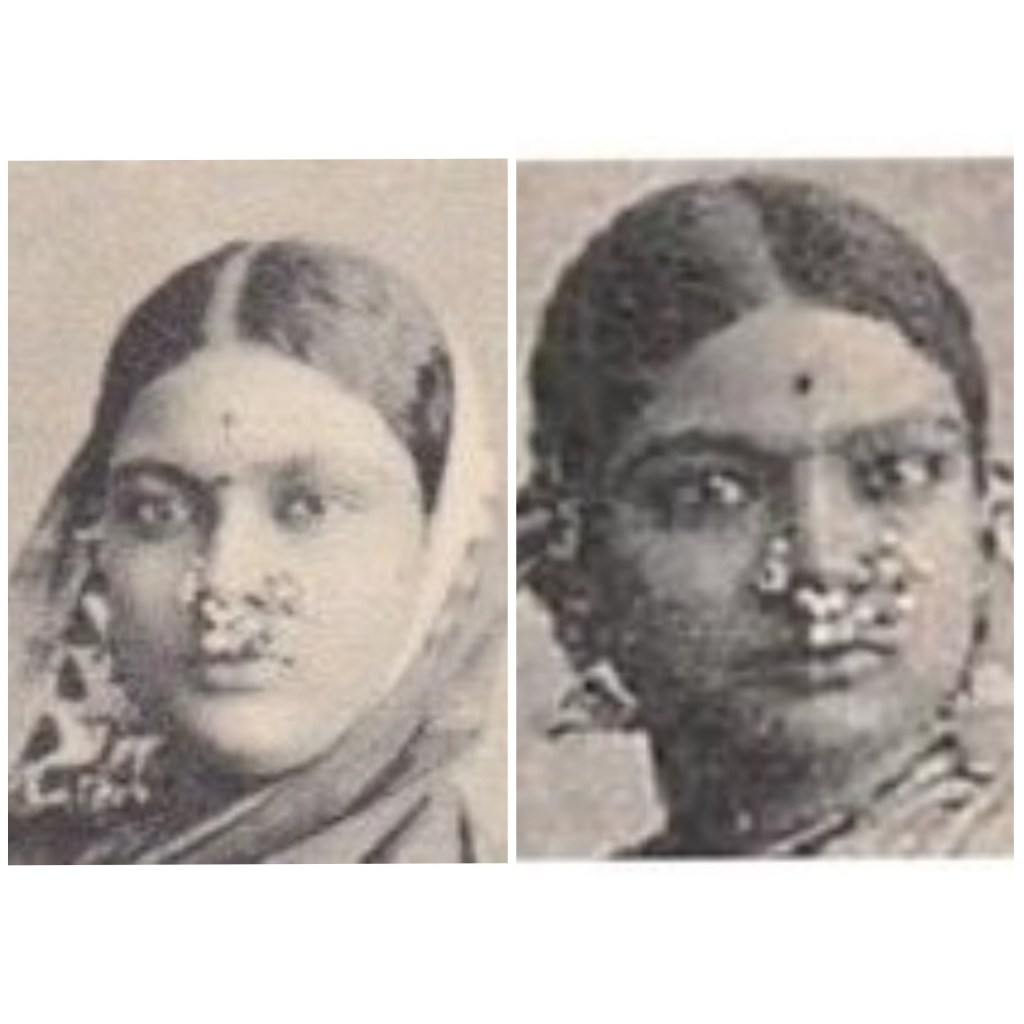
The first distortion occurs around a famous commercial postcard by photographer F.M. Coleman (1897), commercially titled “Brahman Lady”. A careful analysis of the archival sources reveals a fundamental methodological detail that the revisionist approach tends to blur: the commonly circulated color image is nothing more than a hand-painted, re-colored version of an original black-and-white photograph (originally cataloged under the generic caption “Hindu Woman”).

A segment of recent research makes an unjustifiable logical leap by identifying the model in Coleman’s postcard as a young Jatti Thayamma. This identification relies exclusively on superficial and universal ornamental details—such as the style of rings or the placement of nose jewels (mukhutti)—elements that were widely common among women of affluent means throughout late 19th-century South India, and entirely lacking in biunivocal identificatory value.


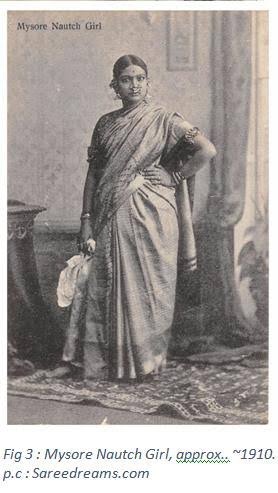
The second and more severe short-circuit involves the overlay with a second archival image, cataloged as “Mysore Nautch Girl”* and dated by British records around 1910. Faced with this source, the thesis of “élitist purity” crashes into an insurmountable anachronism: in 1910, Jatti Thayamma was a mature woman of about fifty-three years old, whereas the model depicted in the photograph is visibly a young girl. Rather than accepting the objective data and questioning the initial hypothesis, the revisionist methodology prefers to dismiss the official archival dating as an “ignorant error” of the British catalogers.

Yet, when placing the faces and physiognomic details of the Coleman postcard (1897) and the 1910 photograph in close proximity, the unsustainability of the thesis becomes glaringly obvious: the bone structure, the oval of the face, and the expression overwhelmingly demonstrate that these are two completely different women.

Finally, this entire operation of visual superimposition is definitively refuted when compared to the authentic and certified archival portrait of Jatti Thayamma. The facial features, the actual bone structure, and the real physiognomy of the maestro show a total and striking discrepancy against the aestheticized and painted idealizations of the commercial postcards used to manufacture her alleged Brahmin identity.

III. The Double-Standard Reliability of Colonial Sources

From the perspective of methodological critique, the treatment reserved for colonial-era archives within this narrative exposes a blatant and unsustainable confirmation bias, resulting in a “double-standard” use of sources.

When a caption appended by a 19th-century British photographer happens to support the researcher’s thesis—as is the case with the commercial label “Brahman Lady” on Coleman’s postcard—the colonial source is instantly elevated to the rank of anthropological dogma and incontestable scientific proof of the model’s lineage. This deliberately ignores the fact that colonial-era photography operated within a tourist and commercial print market, cataloging subjects based on visual stereotypes, the opulence of attire, or the richness of jewelry, without conducting any real genealogical or caste investigation.

Conversely, as already highlighted regarding the 1910 photograph, the exact moment a colonial archive produces a chronological datum that contradicts the researcher’s theory, its authority is abruptly revoked. The British cataloging is suddenly downgraded to a product of approximation and ignorance. This opportunistic approach strips historical research of all neutral rigor: the document ceases to be an instrument of inquiry and mutates into a mere pretext to validate a pre-existing ideological agenda.

IV. Sanskritization vs. Absorption: The Sociological Distortion of the Jatti Caste

To formally justify the label of “Brahmin woman” applied to Jatti Thayamma, revisionist historiography engages in a sociological scramble, attempting to redefine the dancer’s community of birth. Citing classic texts of local anthropology (such as The Mysore Tribes and Castes), it highlights how the Jatti community—historically associated with court wrestlers, bodyguards, and martial entertainers of the Maharaja of Mysore—practiced complex domestic rituals, including the sacred thread ceremony (Upanayana). From this premise, the narrative draws the arbitrary conclusion that the Jatti were “by tradition Brahmins” or had been literally “absorbed” by them.

This thesis represents a severe distortion of the social mechanisms of pre-modern and colonial India. The phenomenon described is not a “caste absorption” (a dynamic that was ritually impossible and thoroughly prevented by the marital endogamy of the era), but rather a textbook process of Sanskritization, as theorized by the sociologist M.N. Srinivas. Through Sanskritization, an intermediate or martial community that had accumulated significant economic power and close proximity to the sovereign adopted the dress codes, vegetarian diet, rituals, and aesthetics of the priestly castes in order to elevate their overall social prestige.

Adopting the lifestyle, ritual purity, or elegance of Brahmins did not transform the Jatti into Brahmins. No member of the priestly caste would have ever considered a court wrestler as a kinsman or a ritual equal. Jatti Thayamma belonged, in every respect, to the Jatti community; the puritanical and modern haste to “cleanse” and “Brahminize” her ultimately and paradoxically erases the extraordinary and fascinating complexity of a martial caste capable of becoming the custodian of a highly refined choreographic and cultural tradition.

V. Conclusion: Post-Truth in the History of Indian Dance

In the final analysis, the deconstruction of the narrative attempting to turn Jatti Thayamma into a “Brahmin dancer” demonstrates that this theory holds no water. It fails to withstand the cross-verification of archival dates, crumbles before the evidence of facial features in the genuine photographic documentation, and fails to correctly apply the most basic concepts of the sociology of Indian castes.

This genre of essay writing does not constitute an objective historical study, but rather functions as an operation of cultural whitewashing and historiographical post-truth. The ideological urgency to legitimize the current ownership of Bharatanatyam by social élites drives the manipulation of the past. It seeks to prove that the art suffered no trauma, censorship, or appropriation, but was instead “already pure” and firmly in the hands of the upper classes since its 19th-century origins.

Restoring Jatti Thayamma to her true identity as a master of the Jatti caste, inextricably linked to the court life of Mysore, is not merely about defending the rigor of historical and archival methodology. Above all, it means doing justice to the memory of the dance and to all those communities who, outside of Brahmin hegemony, created, protected, and passed down the performance heritage of South India before modern history decided to drape it in the artificial veil of ideological distortion.

The Devotee’s Ego and the Performer’s Silence: Deconstructing Patriarchal Ideology in Sivakavi (1943)

A critical analysis of how classical Tamil cinema fabricated the moral infrastructure for the dispossession and erasure of hereditary female artists.

Introduction: Sound Cinema as a Laboratory of Moral Purification

Released in 1943—just four years prior to the passage of the Madras Devadasis Act (1947)—the Tamil devotional film Sivakavi operated as far more than mere spiritual entertainment. It functioned as a sophisticated visual propaganda device designed to redefine public morality and legitimize the impending social and economic erasure of hereditary female artists.

Analyzing Sivakavi today is not an exercise in applying contemporary moralism to an old motion picture; rather, it is a systematic dismantling of the narrative mechanisms through which the 20th-century cultural industry manufactured public consent to dispossess women of their art, wealth, authority, and voice.

1. The Spatial Trap: Temple vs. Court

Historically, hereditary female performers moved with fluidity, authority, and patronage across both the ritual space of the temple and the political space of the royal court. Sivakavi deliberately destroys this historical continuity, fracturing the performer’s persona into two antithetical stereotypes—each tailored to serve the patriarchal order:

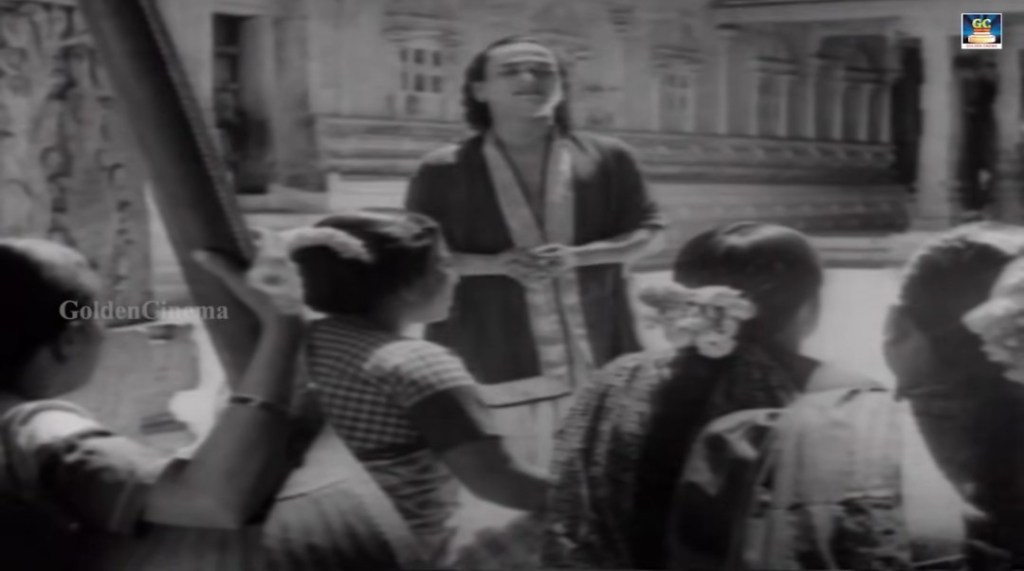
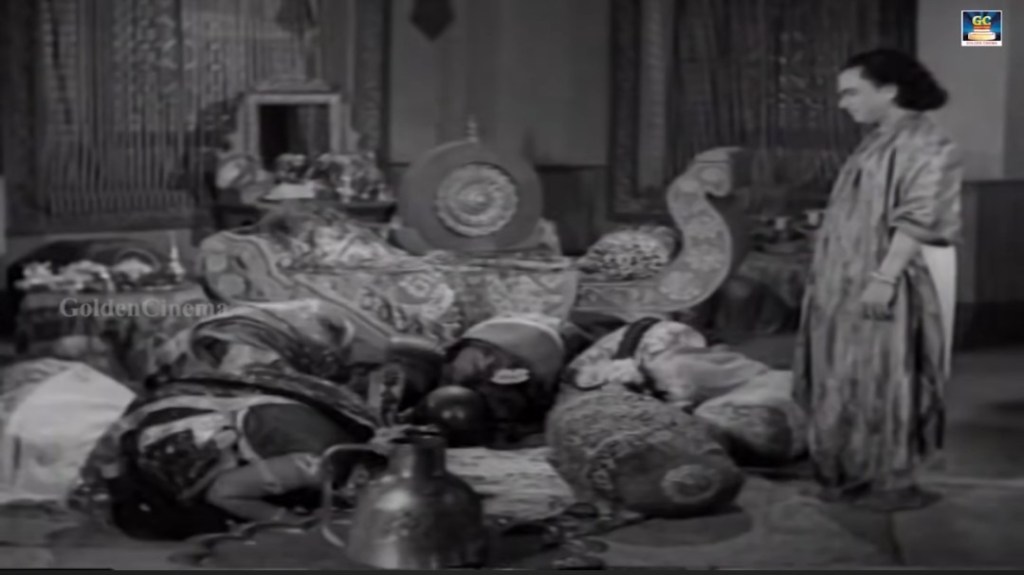
The Temple Performer as a “Pitiable Victim” (Timestamp ~1:20:17): In the Kalayar Kovil sequence, the temple dancers are depicted as impoverished and congenitally blind. This blindness operates as a violent allegory: the hereditary tradition is framed as being “in the dark,” inherently lacking moral vision. Stripped of their technical mastery, the dancers are reduced to passive invalids awaiting the arrival of the male ascetic to grant them sight and spiritual redemption.

The Court Performer as a “Malignant Strategist”: In the courtly realm, embodied by the character Vanji, the narrative flips its tactic. Here, the woman is sighted, educated, autonomous, and in command of her intellectual space. Yet, rather than acknowledging her artistic mastery, the film pathologizes her agency by labeling it as corrupting pride (garvam), manipulative scheme, and a threat to the holy man’s reputation.

Sivakavi confronting the blind temple dancers at Kalayar Kovil. (Screenshot from the movie)

2. The Resistance of the Body: Embodied Mastery vs. Narrative Pathologization

Despite the screenplay’s relentless effort to confine Vanji within the stereotype of an unprincipled temptress, the film contains a striking visual and structural contradiction.

While T. R. Rajakumari did not undergo formal dance training prior to her entry into the cinema, her direct lineage within the hereditary performer community and her collaboration with Vazhuvoor Ramaiah Pillai—a hereditary naṭṭuvaṉār who was actively shaping the choreography of early sound cinema—create a powerful somatic record on screen.

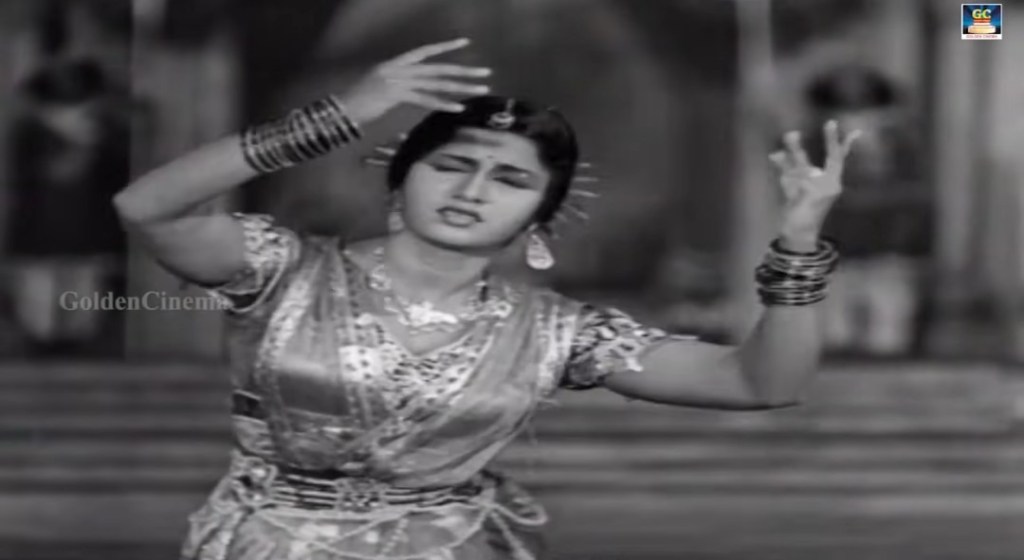
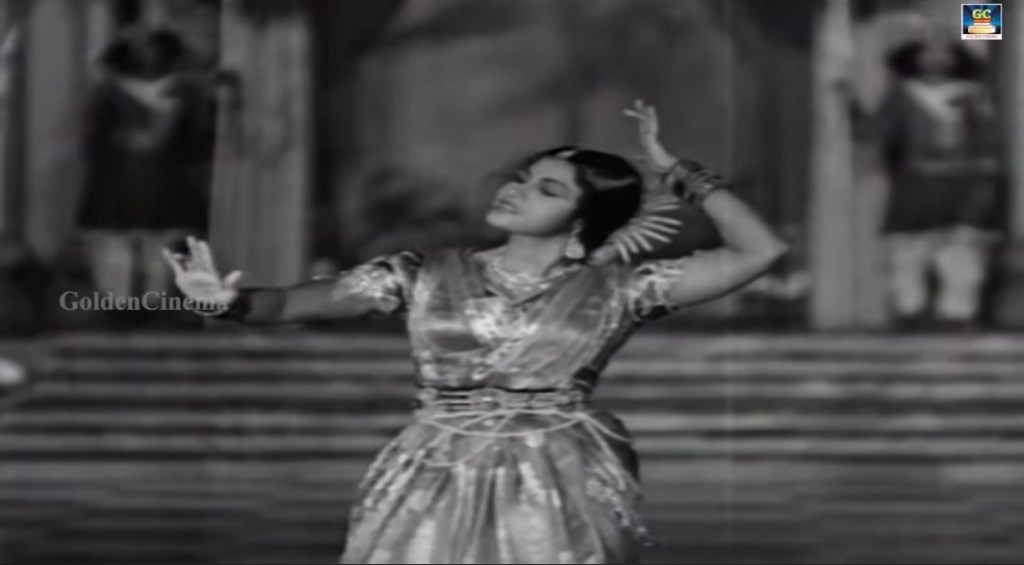
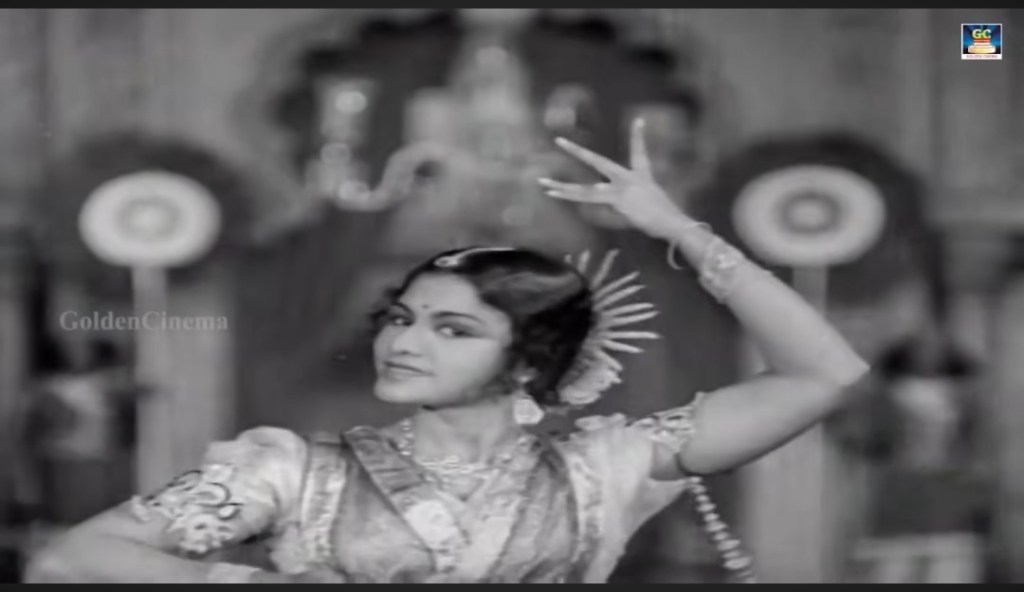
During her performance sequences, Rajakumari’s physical presence, her command of abhinaya (expressive gestural vocabulary), and the spatial authority of her movement transcend the moralistic constraints of the plot. This performance exposes a profound historical irony: while the narrative of Sivakavi seeks to pathologize the hereditary woman as morally obsolete, the film’s visual spectacle relies entirely on the aesthetic sophistication, screen presence, and technical mastery generated by hereditary artists and choreographers. On screen, the narrative attempts to condemn Vanji, but the camera captures an undeniable display of artistic authority that refutes the film’s moralizing agenda.

T. R. Rajakumari performing as Vanji. (Screenshots from the movie)

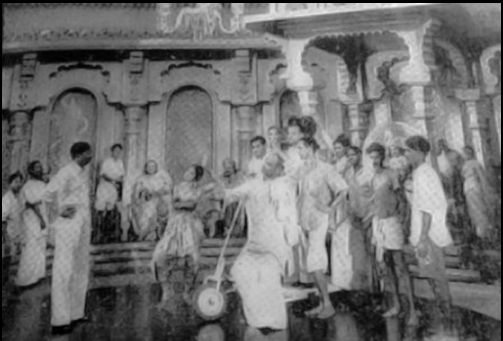
Vazhuvoor Ramaiah Pillai choreographing T. R. Rajakumari on the set of Sivakavi (1943). This archival photograph illustrates the material collaboration between hereditary performers and nattuvanars in shaping early Tamil cinema dance. Source: Reproduced from Hari Krishnan, Celluloid Classicism: Early Tamil Cinema and the Making of Modern Bharatanatyam (originally from Suresh Balakrishnan, Bagavather: His Life and Times, 2010).

3. The Gold Cycle and the Double Condemnation of the Female Sphere

The narrative arc of the bag of gold reveals the complete mechanics of the film’s moral and financial economy, operating through a two-fold extraction:

The Performative Refusal & Extraction (Timestamp ~2:39:10): Initially declining the gold offered by the healed dancers to project ascetic detachment, Sivakavi later backtracks when capital is needed for his mission. Confronted with the women’s hesitation, he accuses them of “greed,” curses the matriarch with blindness, and accepts the wealth only after they prostrate themselves in penance. Female financial autonomy is thus stigmatized and forcibly surrendered.  

Domestic Re-allocation & Divine Punishment (Timestamp ~2:46:38): Carrying the extracted gold, Sivakavi attempts to justify its possession to the disguised Lord Murugan by framing it as necessary support for his domestic household: “I only wish to take this little gold to my wife so that she may sustain herself.” The narrative shifts the stigma of material accumulation from the poet onto female domestic survival.  

The Purification of Male Ego (Timestamp ~2:51:07): Murugan rejects this justification, exposing the poet’s hypocritical vanity (aganthai) and punishing his attachment to material goods. Through the subsequent destruction of his domestic ties and the death of his wife, the gold is stripped of its earthly/female associations and fully converted into male spiritual merit.  

The economic dispossession is thus absolute: the wealth generated by hereditary female artistry is first extracted under the pretense of cleansing “courtesan greed,” briefly re-routed to serve male domestic needs, and finally obliterated to fuel the male saint’s ascetic elevation.

The women prostrating before Sivakavi to surrender the bag of gold. (Screenshot from the movie)

4. Sanctified Ego and Victim Blaming

The crux of the film lies in the double standard applied to the male protagonist’s behavior. Sivakavi enters the royal court with an immense ego, insulting resident poets and demanding complete deference. However, the narrative executes a clever inversion:

Male Aggression as “Sacred Zeal”: The poet’s arrogance is glorified as incorruptible righteousness and devotion to the language and the divine. Speaking in the name of God grants him absolute moral immunity.

Female Resistance as “Conspiracy”: Any attempt by Vanji to defend her status or dignity against the poet’s hostility is framed as an insidious plot.

The film enforces a classic victim blaming dynamic: the social conflicts and scandals caused by the saint’s own belligerence are blamed entirely on the malice of the court courtesan.

5. The Gendered Taxonomy of Pride: The “Pure Wife” vs. The “Proud Courtesan”

In a key dialogue with Minister Chinnoo (Timestamp ~1:55:38), Sivakavi explicitly lays out the film’s gender ideology. When discussing Vanji’s intellect and education, the poet dismisses her agency by naturalizing her pride (garvam):

“Vanji is well-educated, but she possesses pride. After all, she is a woman, and it is natural for pride to accompany her.”

To reassure the Minister, Sivakavi immediately introduces the archetype of the “virtuous woman,” invoking the traditional metaphor of the niraikudam (the vessel filled to the brim with water, which remains silent and does not spill):

“Pride never approaches those whose minds are filled with wisdom and virtue like a full vessel.”

This exchange completes the film’s moral taxonomy of womanhood:

The Autonomous Artist (Vanji): Educated, self-sufficient, and vocal, her intellect is automatically pathologized as inherently flawed “female pride.”

The Domestic Wife (The Minister’s Spouse): Virtuous precisely because her intellect is contained, passive, and subservient to male authority.

By asserting that autonomy in a woman is an inherent moral defect, the screenplay validates the broader societal mandate: the hereditary female performer must either be domesticated into silent submission or completely purged from public space.

6. Colonial Anxiety and the Politics of “Purification”

The narrative shift in Sivakavi—where the royal court gradually disdains traditional poets and artists to embrace the austere poet-saint—reflects a profound historical anxiety: the mid-20th-century bourgeois drive to sanitize South Indian performing arts under the gaze of British colonialism.

In response to colonial accusations of “immorality” regarding hereditary performance traditions, the nationalist and reformist elite sought to manufacture a “respectable,” standardized, and sterile form of classical art. Sivakavi constructs a narrative justification for this expropriation by portraying the court’s traditional aesthetic space as obsolete and corrupt, presenting Sivakavi’s ascetic devotion as the only “pure” alternative.

Furthermore, Vanji’s critical actions—often mischaracterized by the screenplay as mere “female pride” (garvam) or spite—were, in reality, strategic maneuvers of alignment. In challenging Sivakavi and proposing a union, Vanji was negotiating survival within a rapidly shifting political landscape that threatened her community’s livelihood. By reframing her political acuity as a malicious attempt to “tarnish the saint’s reputation,” the film’s victim-blaming narrative masked a deliberate campaign of cultural and economic displacement under the guise of spiritual renewal.

Conclusion: An Expropriative Canon

Sivakavi successfully disseminated a foundational axiom of mid-20th-century bourgeois reform: art does not belong to those who have preserved and practiced it for generations, but only to those deemed “spiritually pure” and morally elevated.

By establishing the male devotee as the sole “eligible” custodian of beauty and sanctity, the film framed the material and cultural dispossession of the hereditary community not as an act of state-sanctioned violence, but as a necessary duty of national purification. Deconstructing these cinematic texts is an essential first step toward restoring historical truth to those whose voices were systematically converted into silence.

The Trap of Feed Propaganda: Decontextualization, Puritanism, and the Stigma of the Oppressed

1. The Short Circuit of Viral Narratives

In recent period, digital discourse surrounding the historical and community practices of hereditary dancers and various forms of dedication has undergone progressive trivialization. We regularly witness a flood of high-impact visual graphics, posts engineered for instant outrage, and slogans claiming a “progressive” or anti-caste lineage. Yet, beneath this veneer of digital activism lies a deep continuity with early 20th-century colonial and bourgeois narratives.

Social media propaganda does not seek archival complexity; it thrives on shock value. To secure rapid consensus and algorithmic visibility, it systematically resorts to decontextualization, moral oversimplification, and the reduction of centuries-old histories into mere trophies for a “cultural war” waged from positions of privilege.

2. The Harm of “Convenient Syncretism”: Blurring Irreconcilable Historical and Caste Contexts

The primary and most severe methodological flaw of digital propaganda is the total erasure of historical, geographical, and caste coordinates. We observe an arbitrary blurring of boundaries: the complex urban, courtly, and temple realities of hereditary practitioners (such as the Kalāvantulu / Isai Vellalar communities of Tamil Nadu and Andhra Pradesh) are indiscriminately fused and confused with marginalized rural dedication systems, such as the Yellamma or Mathamma cults across Karnataka, Andhra Pradesh, and Telangana.

This forced convergence inflicts devastating historiographical and political damage:

  • The Eradication of Śūdra Somatic Sovereignty: Flattening the history of patronage, musical mastery, land ownership (inām), and economic independence embodied by hereditary Śūdra women into a monolithic narrative of “prostitution, pedophilia, and sheer degradation” constitutes a second act of dispossession. It retrospectively applies the very same puritanical lens used by colonial administrators and bourgeois reformers to strip these women of their material rights and artistic heritage. Recognizing that this historical system was complex and inherently imperfect does not mean equating its social mechanics with rural atrocity.
  • The Erasure of Dalit Material Vulnerability: Conversely, rural dedication systems like Yellamma overwhelmingly involve Dalit women (Avarna), who were historically segregated, denied land ownership, and subjected to systemic economic coercion. Applying the aesthetic-political categories of urban Sabha debates to these village contexts prevents us from analyzing rural vulnerability for what it truly is: the product of precise land-tenure relations, poverty, and caste domination enforced by local agrarian elites.

Treating historically, structurally, and sociologically distinct phenomena as a single, monolithic “aggregate of backwardness” serves neither to comprehend the past nor to achieve justice in the present. It exists solely to construct a simplified narrative tailored for algorithmic consumption.

3. The Genealogy of Respectability Politics and Reformist Compromise

The tendency to demonize hereditary performers while ignoring rural economic exploitation is rooted in the history of modern reformist politics. In the race to challenge Brahminical hegemony and assert modern legitimacy, early to mid-20th-century non-Brahmin and Dravidian reform movements frequently internalized Victorian colonial puritanism and bourgeois morals (respectability politics).

To present a “clean,” modern, and rational society to the world, the autonomous Śūdra female artist—who held land, managed her own assets, and operated outside the nuclear, monogamous family structure—was turned into a convenient scapegoat. Eliminating her public presence allowed reformist movements to claim a moral victory over the old order at no cost to the emerging agrarian classes.

Crucially, this moralizing crusade left the underlying material structures of oppression untouched. Truly addressing the vulnerability of rural Dalit women in systems like Yellamma would have required radical land reforms and a direct confrontation with dominant-caste landowners (Śūdra intermediate elites) who formed the economic backbone of these political movements. It was infinitely more convenient to wage a puritanical war against the bodies of hereditary artists than to dismantle the land-based power of agrarian landlords.

4. From Puritanism to Victim Blaming: The Hypocrisy of “Salvation”

When digital propaganda addresses contexts of deep rural marginality, the hypocrisy of this approach emerges in full force. Instead of directing the spotlight onto the structural mechanisms that generate exploitation—dominant landlords, ruling agrarian castes, lack of property rights, and systemic poverty—the narrative imperceptibly shifts the blame onto the victimized communities themselves.

Through a vocabulary steeped in paternalism, the oppressed woman is framed through categories of “contamination,” “moral degradation,” or total passivity. This reproduces the classic mechanism of victim blaming:

  • Responsibilities Shifted to the Oppressed: Subordination is treated as a moral stigma or a cultural choice of the marginalized group itself, framing mothers and women in these communities as perpetrators or custodians of “immoral practices,” rather than as individuals navigating severe structural violence.
  • Absolution of the System: By focusing on the moral judgment of the practice or the individual, public discourse fails to confront the material perpetrators of exploitation: the landlords, local patriarchs, and state apparatuses that profit from that vulnerability.
  • Reification of Suffering: The trauma and deprivation of these communities are transformed into a digital fetish, once again stripping these women of their voice, their political agency, and their historical dignity.

5. Toward an Ethics of Complexity: Restoring Historical Accountability

An analysis that purports to be truly intersectional and rigorous must firmly reject the shortcuts of digital propaganda. Social critique cannot be achieved while remaining bogged down in the hypocrisy of bourgeois puritanism and selective historical amnesia.

Deconstructing toxic social media narratives requires asserting a fundamental ethical principle: the responsibility for exploitation rests solely and entirely on the systems of power that produce it and the perpetrators who profit from it—never on those who bear its weight.

Restoring truth to history demands separating distinct caste and economic contexts, studying agrarian land structures, respecting somatic and hereditary sovereignty, and ceasing the use of others’ suffering as leverage for digital visibility and moral posturing. Only by dismantling stigma and decontextualization can we build an archival and analytical space that is genuinely liberating.

The Colonial Invention of the “Modern Hierodule” and the Dispossession of Hereditary Women Artists in South India

Abstract

This essay examines the colonial construction of the “modern hierodule” as an interpretive category applied to hereditary women artists in South India. Produced through Victorian classicism, colonial ethnography, and moral reform discourse, this analogy—explicitly formulated by figures like Dr. John Shortt—legitimized the dismantling of hereditary artistic institutions. Absorbed by the Indian reformist elite, the archetype became a powerful instrument in stripping hereditary communities of their land rights (inām), social authority, and cultural capital, proving that the “modern hierodule” was an ideological tool of epistemic power rather than an objective historical reality.

Introduction: From Eryx to South India

Historical categories rarely travel untouched. Across the nineteenth century, British colonial scholars interpreted South Indian institutions through analogies borrowed from Mediterranean antiquity, notably associating hereditary women artists with the hierodule (sacred servant).

This translation was far from neutral. European intellectual culture had already transformed the ancient Mediterranean into a moralized landscape of “sacred prostitution” and pagan survivals. Projected onto South Indian performers, this pre-existing Victorian framework produced the archetype of the “modern hierodule”—a colonial construct through which hereditary artistic communities were classified, regulated, and ultimately dispossessed.

1. The Victorian Reinvention of the Hierodule

The Greek term hierodoulos (“sacred servant”) referred to individuals dedicated to sanctuary service with varied regional functions. Victorian scholarship, however, reinterpreted ancient Mediterranean religions through a Christian moral lens, reducing these practices to fertility cults and moral degradation.

This ideological construct was directly exported to colonial India. In his address to the Anthropological Society of London (1868), Dr. John Shortt explicitly compared South Indian performers to the hierodouloi of Aphrodite at Corinth described by Strabo. Rather than engaging with indigenous genealogies or regional histories, Shortt translated South Indian artists into a familiar European narrative of pagan decay. The “modern hierodule” thus emerged from a double projection: Mediterranean antiquity was reconstructed through Victorian morality, and that reconstructed antiquity was imposed onto South Indian communities.

2. Inventing the “Devadasi”: Administrative Flattening

A parallel process unfolded within British administrative governance. Colonial authorities collapsed distinct social realities under the umbrella category “devadasi.” Highly specialized, urban, and courtly artistic communities—such as the Isai Vellalar and Kalāvantulu—were indiscriminately conflated with rural dedication systems possessing entirely different socio-economic structures.

This administrative flattening mirrored the Victorian reinvention of the hierodule: diverse, complex social systems were reduced to a single monolithic archetype designed to sustain narratives of moral reform and civilizational progress.

3. Structural Incompatibility: Why the Analogy Fails

The comparison between Mediterranean hierodouloi and South Indian hereditary artists obscures fundamental structural differences:

  • Mediterranean Hierodouloi: Belonged to systems of sanctuary dependency where social status derived primarily from the temple institution itself.
  • South Indian Hereditary Artists: Occupied a distinct socio-economic position grounded in professional artistic mastery, hereditary transmission of knowledge, ritual specialization, and landholding rights (inām) embedded in precolonial state structures.

Their identity was not defined by passive temple servitude, but by systemic authority and sophisticated mastery over music, dance, poetry, and pedagogy. The colonial analogy fatally confused shared participation in religious space with institutional equivalence.

4. Embodied Aesthetics vs. Victorian Moralism

A central colonial misreading lay in the treatment of śṛṅgāra (the aesthetic sentiment of love, longing, and desire). While South Indian aesthetic traditions treated embodiment as a vehicle for devotional and artistic expression, colonial observers viewed performance through Victorian binaries that opposed sensuality to spirituality.

By transforming aesthetic embodiment into “sexual evidence,” colonial discourse reduced artistic performance to moral delinquency, rendering the performer legible only as a “degraded hierodule.”

5. Elite Reform and the Mechanics of Dispossession

The enduring impact of the “modern hierodule” archetype was sealed when the educated Indian elite adopted colonial classifications within their own nationalist and social reform agendas. Framed through the lens of Victorian respectability, the hereditary artist was cast as an obsolete remnant of a degraded past, allowing state and social intervention to be framed as “rescue” rather than dispossession.

The consequences were profound and paradoxical:

  • The repertoire was elevated as national culture, while the communities who created and safeguarded it were stigmatized.
  • The art was institutionalized and preserved, while its historical female custodians were systematically displaced from their land rights, social authority, and livelihoods.

Conclusion: Beyond Epistemic Power

The genealogy of the “modern hierodule” demonstrates how historical categories travel across empire to exercise epistemic power—the power to name, classify, and erase. Imported through classicist analogies by observers like Shortt, the category served to transform economic and social dispossession into the moral language of salvation.

Deconstructing this colonial archetype is a necessary step toward dismantling bourgeois puritanism and restoring historical agency, artistic legitimacy, and structural truth to hereditary women artists.

Blog su WordPress.com.

Su ↑

È questo il tuo nuovo sito? Accedi per attivare le funzionalità di amministrazione e ignora questo messaggio
Accedi