
A critical analysis of how classical Tamil cinema fabricated the moral infrastructure for the dispossession and erasure of hereditary female artists.
Introduction: Sound Cinema as a Laboratory of Moral Purification
Released in 1943—just four years prior to the passage of the Madras Devadasis Act (1947)—the Tamil devotional film Sivakavi operated as far more than mere spiritual entertainment. It functioned as a sophisticated visual propaganda device designed to redefine public morality and legitimize the impending social and economic erasure of hereditary female artists.
Analyzing Sivakavi today is not an exercise in applying contemporary moralism to an old motion picture; rather, it is a systematic dismantling of the narrative mechanisms through which the 20th-century cultural industry manufactured public consent to dispossess women of their art, wealth, authority, and voice.
1. The Spatial Trap: Temple vs. Court
Historically, hereditary female performers moved with fluidity, authority, and patronage across both the ritual space of the temple and the political space of the royal court. Sivakavi deliberately destroys this historical continuity, fracturing the performer’s persona into two antithetical stereotypes—each tailored to serve the patriarchal order:
The Temple Performer as a “Pitiable Victim” (Timestamp ~1:20:17): In the Kalayar Kovil sequence, the temple dancers are depicted as impoverished and congenitally blind. This blindness operates as a violent allegory: the hereditary tradition is framed as being “in the dark,” inherently lacking moral vision. Stripped of their technical mastery, the dancers are reduced to passive invalids awaiting the arrival of the male ascetic to grant them sight and spiritual redemption.
The Court Performer as a “Malignant Strategist”: In the courtly realm, embodied by the character Vanji, the narrative flips its tactic. Here, the woman is sighted, educated, autonomous, and in command of her intellectual space. Yet, rather than acknowledging her artistic mastery, the film pathologizes her agency by labeling it as corrupting pride (garvam), manipulative scheme, and a threat to the holy man’s reputation.
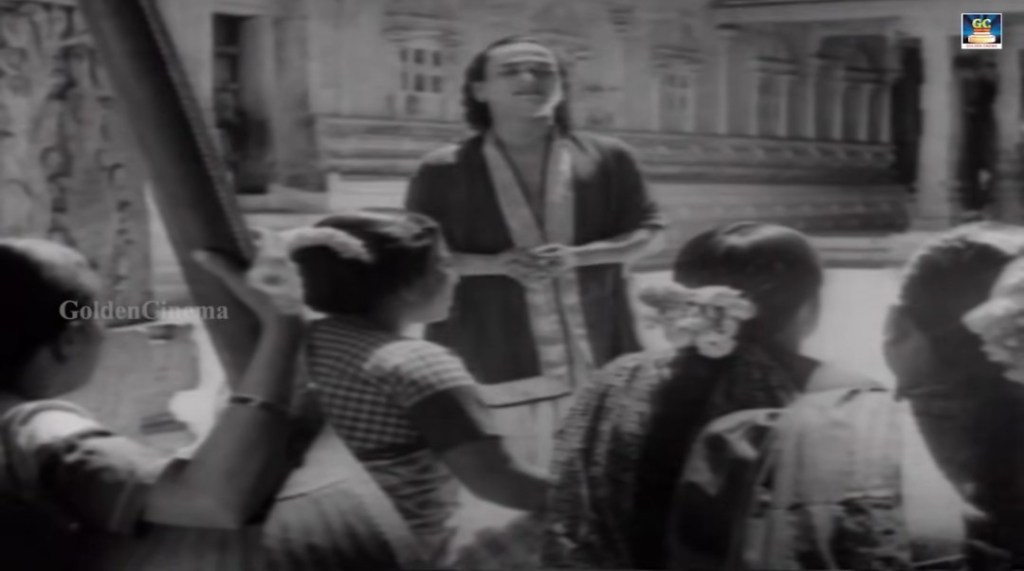
Sivakavi confronting the blind temple dancers at Kalayar Kovil. (Screenshot from the movie)
2. The Resistance of the Body: Embodied Mastery vs. Narrative Pathologization
Despite the screenplay’s relentless effort to confine Vanji within the stereotype of an unprincipled temptress, the film contains a striking visual and structural contradiction.
While T. R. Rajakumari did not undergo formal dance training prior to her entry into the cinema, her direct lineage within the hereditary performer community and her collaboration with Vazhuvoor Ramaiah Pillai—a hereditary naṭṭuvaṉār who was actively shaping the choreography of early sound cinema—create a powerful somatic record on screen.
During her performance sequences, Rajakumari’s physical presence, her command of abhinaya (expressive gestural vocabulary), and the spatial authority of her movement transcend the moralistic constraints of the plot. This performance exposes a profound historical irony: while the narrative of Sivakavi seeks to pathologize the hereditary woman as morally obsolete, the film’s visual spectacle relies entirely on the aesthetic sophistication, screen presence, and technical mastery generated by hereditary artists and choreographers. On screen, the narrative attempts to condemn Vanji, but the camera captures an undeniable display of artistic authority that refutes the film’s moralizing agenda.
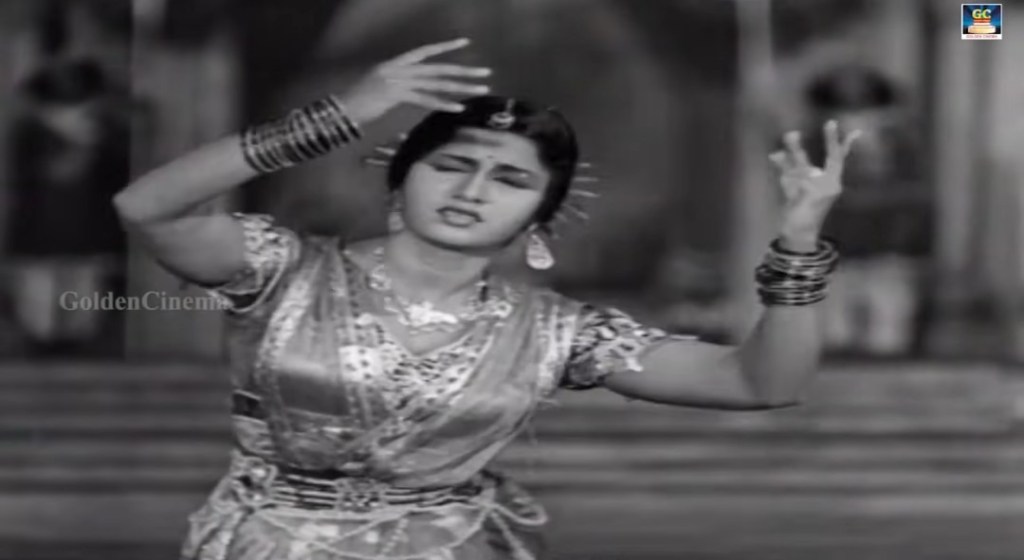
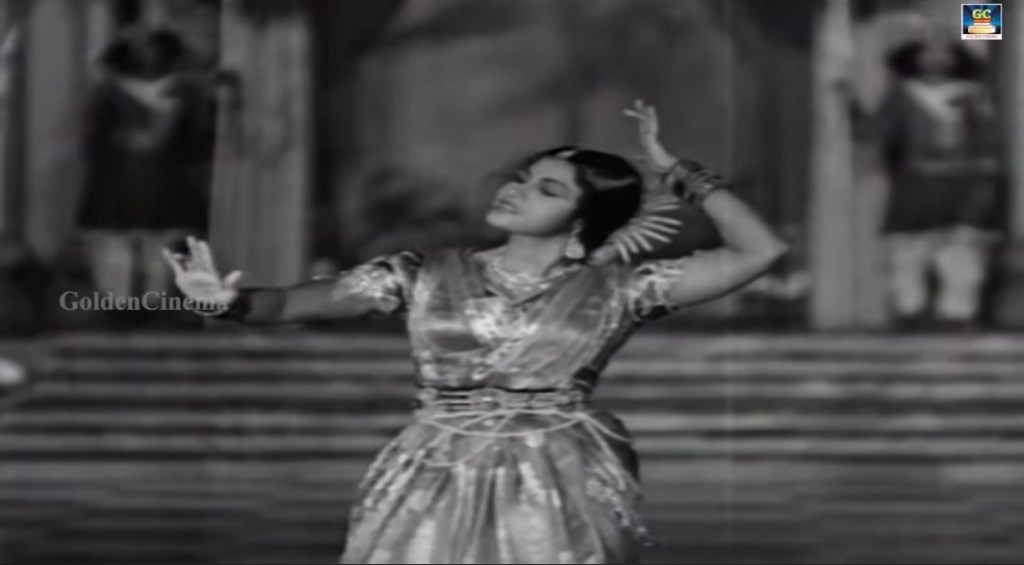
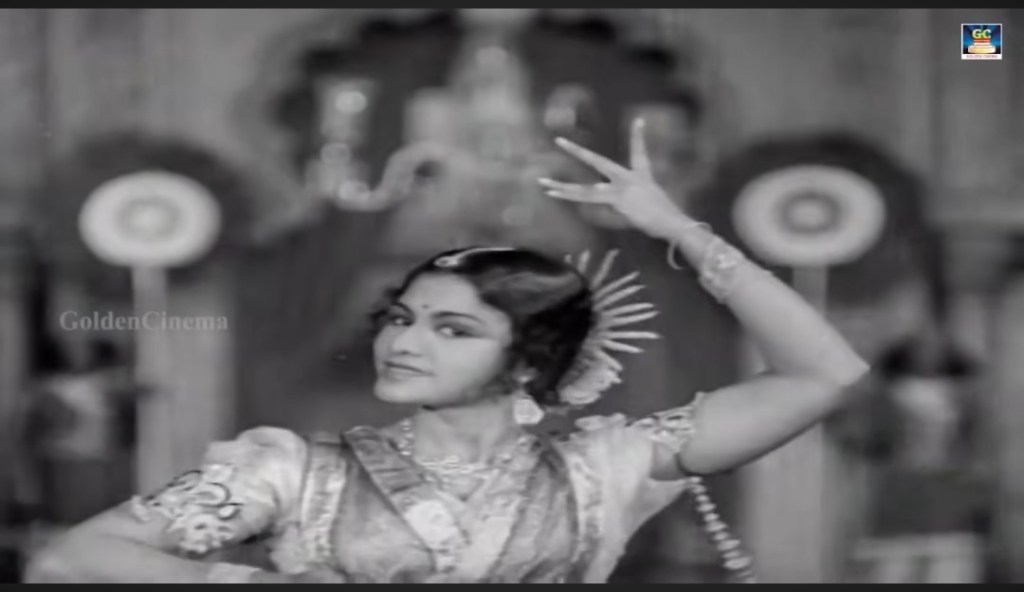
T. R. Rajakumari performing as Vanji. (Screenshots from the movie)
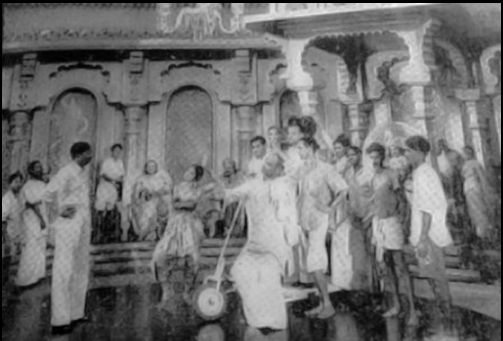
Vazhuvoor Ramaiah Pillai choreographing T. R. Rajakumari on the set of Sivakavi (1943). This archival photograph illustrates the material collaboration between hereditary performers and nattuvanars in shaping early Tamil cinema dance. Source: Reproduced from Hari Krishnan, Celluloid Classicism: Early Tamil Cinema and the Making of Modern Bharatanatyam (originally from Suresh Balakrishnan, Bagavather: His Life and Times, 2010).
3. The Gold Cycle and the Double Condemnation of the Female Sphere
The narrative arc of the bag of gold reveals the complete mechanics of the film’s moral and financial economy, operating through a two-fold extraction:
The Performative Refusal & Extraction (Timestamp ~2:39:10): Initially declining the gold offered by the healed dancers to project ascetic detachment, Sivakavi later backtracks when capital is needed for his mission. Confronted with the women’s hesitation, he accuses them of “greed,” curses the matriarch with blindness, and accepts the wealth only after they prostrate themselves in penance. Female financial autonomy is thus stigmatized and forcibly surrendered.
Domestic Re-allocation & Divine Punishment (Timestamp ~2:46:38): Carrying the extracted gold, Sivakavi attempts to justify its possession to the disguised Lord Murugan by framing it as necessary support for his domestic household: “I only wish to take this little gold to my wife so that she may sustain herself.” The narrative shifts the stigma of material accumulation from the poet onto female domestic survival.
The Purification of Male Ego (Timestamp ~2:51:07): Murugan rejects this justification, exposing the poet’s hypocritical vanity (aganthai) and punishing his attachment to material goods. Through the subsequent destruction of his domestic ties and the death of his wife, the gold is stripped of its earthly/female associations and fully converted into male spiritual merit.
The economic dispossession is thus absolute: the wealth generated by hereditary female artistry is first extracted under the pretense of cleansing “courtesan greed,” briefly re-routed to serve male domestic needs, and finally obliterated to fuel the male saint’s ascetic elevation.
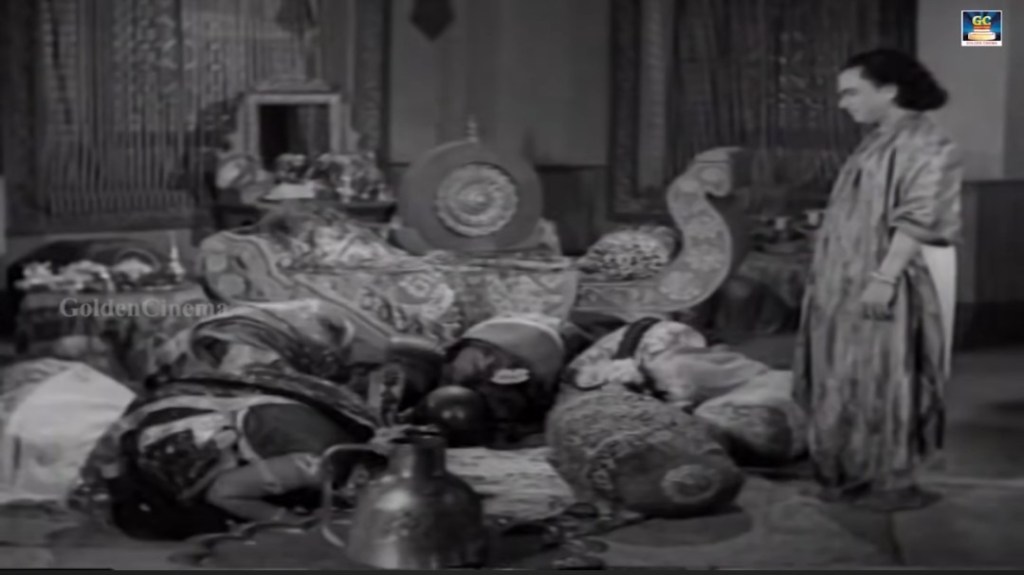
The women prostrating before Sivakavi to surrender the bag of gold. (Screenshot from the movie)
4. Sanctified Ego and Victim Blaming
The crux of the film lies in the double standard applied to the male protagonist’s behavior. Sivakavi enters the royal court with an immense ego, insulting resident poets and demanding complete deference. However, the narrative executes a clever inversion:
Male Aggression as “Sacred Zeal”: The poet’s arrogance is glorified as incorruptible righteousness and devotion to the language and the divine. Speaking in the name of God grants him absolute moral immunity.
Female Resistance as “Conspiracy”: Any attempt by Vanji to defend her status or dignity against the poet’s hostility is framed as an insidious plot.
The film enforces a classic victim blaming dynamic: the social conflicts and scandals caused by the saint’s own belligerence are blamed entirely on the malice of the court courtesan.
5. The Gendered Taxonomy of Pride: The “Pure Wife” vs. The “Proud Courtesan”
In a key dialogue with Minister Chinnoo (Timestamp ~1:55:38), Sivakavi explicitly lays out the film’s gender ideology. When discussing Vanji’s intellect and education, the poet dismisses her agency by naturalizing her pride (garvam):
“Vanji is well-educated, but she possesses pride. After all, she is a woman, and it is natural for pride to accompany her.”
To reassure the Minister, Sivakavi immediately introduces the archetype of the “virtuous woman,” invoking the traditional metaphor of the niraikudam (the vessel filled to the brim with water, which remains silent and does not spill):
“Pride never approaches those whose minds are filled with wisdom and virtue like a full vessel.”
This exchange completes the film’s moral taxonomy of womanhood:
The Autonomous Artist (Vanji): Educated, self-sufficient, and vocal, her intellect is automatically pathologized as inherently flawed “female pride.”
The Domestic Wife (The Minister’s Spouse): Virtuous precisely because her intellect is contained, passive, and subservient to male authority.
By asserting that autonomy in a woman is an inherent moral defect, the screenplay validates the broader societal mandate: the hereditary female performer must either be domesticated into silent submission or completely purged from public space.
6. Colonial Anxiety and the Politics of “Purification”
The narrative shift in Sivakavi—where the royal court gradually disdains traditional poets and artists to embrace the austere poet-saint—reflects a profound historical anxiety: the mid-20th-century bourgeois drive to sanitize South Indian performing arts under the gaze of British colonialism.
In response to colonial accusations of “immorality” regarding hereditary performance traditions, the nationalist and reformist elite sought to manufacture a “respectable,” standardized, and sterile form of classical art. Sivakavi constructs a narrative justification for this expropriation by portraying the court’s traditional aesthetic space as obsolete and corrupt, presenting Sivakavi’s ascetic devotion as the only “pure” alternative.
Furthermore, Vanji’s critical actions—often mischaracterized by the screenplay as mere “female pride” (garvam) or spite—were, in reality, strategic maneuvers of alignment. In challenging Sivakavi and proposing a union, Vanji was negotiating survival within a rapidly shifting political landscape that threatened her community’s livelihood. By reframing her political acuity as a malicious attempt to “tarnish the saint’s reputation,” the film’s victim-blaming narrative masked a deliberate campaign of cultural and economic displacement under the guise of spiritual renewal.
Conclusion: An Expropriative Canon
Sivakavi successfully disseminated a foundational axiom of mid-20th-century bourgeois reform: art does not belong to those who have preserved and practiced it for generations, but only to those deemed “spiritually pure” and morally elevated.
By establishing the male devotee as the sole “eligible” custodian of beauty and sanctity, the film framed the material and cultural dispossession of the hereditary community not as an act of state-sanctioned violence, but as a necessary duty of national purification. Deconstructing these cinematic texts is an essential first step toward restoring historical truth to those whose voices were systematically converted into silence.

