I. Introduction: The Case of Jatti Thayamma and Caste Revisionism
In contemporary historiography dedicated to the performing arts of South India, the historical figure of Jatti Thayamma (1857–1947), a pillar and icon of the Mysore Bani of Bharatanatyam, occupies a position of unquestionable prestige. In recent years, however, her biography and social identity have become the chosen ground for a precise operation of historiographical rewriting by a specific current of research. This trend aims to uproot the illustrious dancer and teacher from her actual historical and communitarian context in order to forcibly insert her into a narrative of “élitist purity” and belonging to the priestly caste.
The underlying ideological objective of this operation is evident: to backdate the practice and preservation of Bharatanatyam to the upper classes (specifically, the Brahmin caste) as early as the 19th century. In doing so, it attempts to defuse and refute the complex historical debate regarding the cultural appropriation of Bharathanatyam suffered by the traditional hereditary communities during the revivalism and moral “cleansing” of the 20th century.
This essay aims to demonstrate that the recent narrative labeling Jatti Thayamma as a “Brahmin woman” does not rest on solid scientific ground or objective archival evidence. Instead, it is built upon a fragile methodological house of cards characterized by arbitrary iconographic manipulations, distorted sociological interpretations, and an opportunistic utilization of colonial sources.
II. The Iconographic Illusion: The Fabrication of a Visual Identity
The visual pillar supporting this revisionist operation is a comparative framework that links three distinct images, which are otherwise devoid of any certified historical correlation.
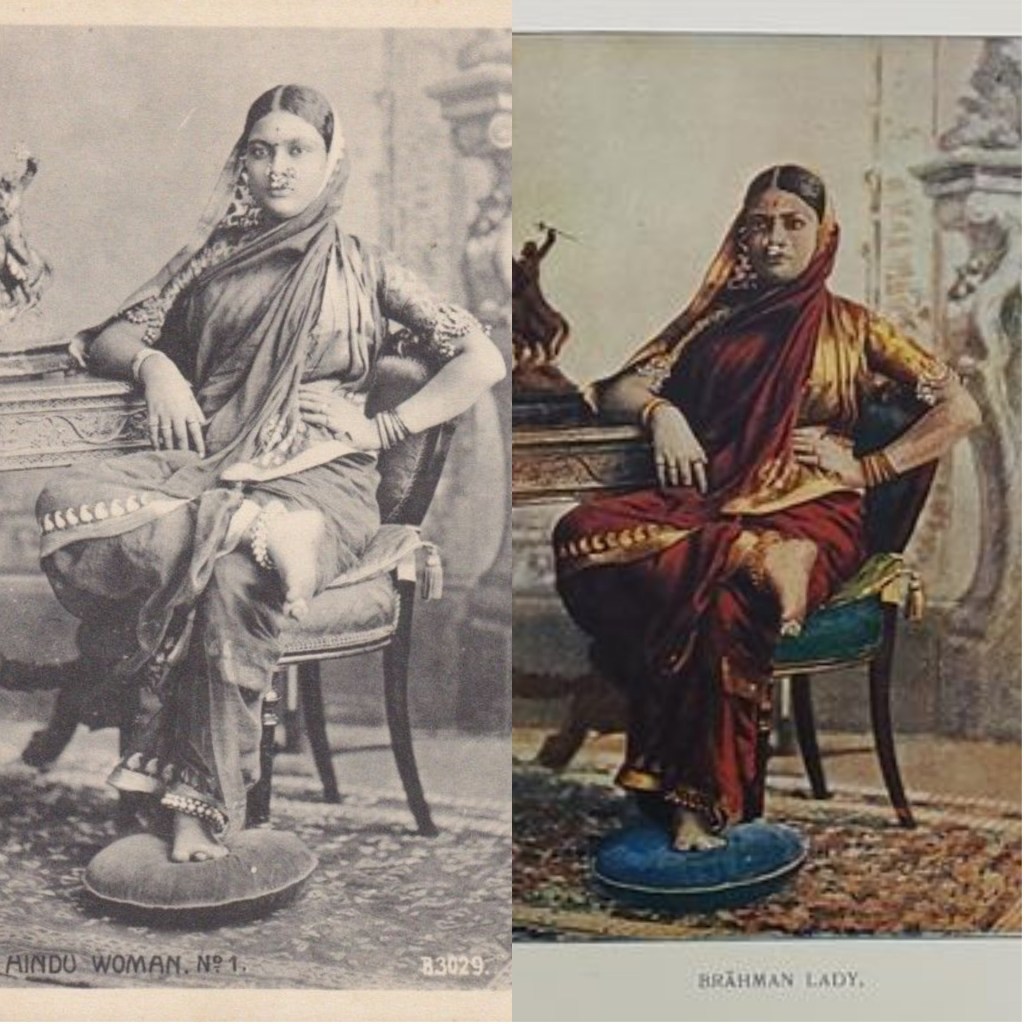
The first distortion occurs around a famous commercial postcard by photographer F.M. Coleman (1897), commercially titled “Brahman Lady”. A careful analysis of the archival sources reveals a fundamental methodological detail that the revisionist approach tends to blur: the commonly circulated color image is nothing more than a hand-painted, re-colored version of an original black-and-white photograph (originally cataloged under the generic caption “Hindu Woman”).
A segment of recent research makes an unjustifiable logical leap by identifying the model in Coleman’s postcard as a young Jatti Thayamma. This identification relies exclusively on superficial and universal ornamental details—such as the style of rings or the placement of nose jewels (mukhutti)—elements that were widely common among women of affluent means throughout late 19th-century South India, and entirely lacking in biunivocal identificatory value.
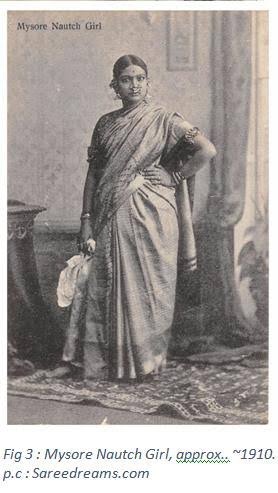
The second and more severe short-circuit involves the overlay with a second archival image, cataloged as “Mysore Nautch Girl”* and dated by British records around 1910. Faced with this source, the thesis of “élitist purity” crashes into an insurmountable anachronism: in 1910, Jatti Thayamma was a mature woman of about fifty-three years old, whereas the model depicted in the photograph is visibly a young girl. Rather than accepting the objective data and questioning the initial hypothesis, the revisionist methodology prefers to dismiss the official archival dating as an “ignorant error” of the British catalogers.
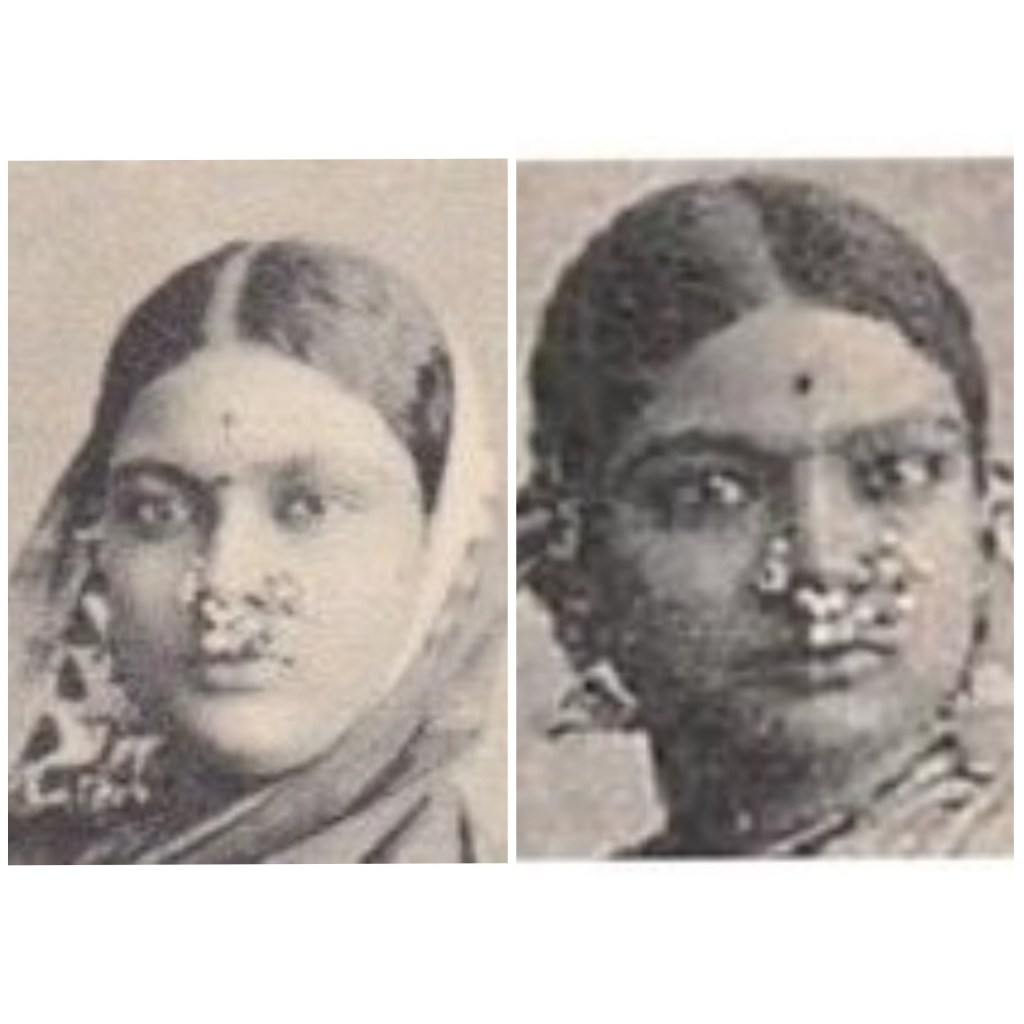
Yet, when placing the faces and physiognomic details of the Coleman postcard (1897) and the 1910 photograph in close proximity, the unsustainability of the thesis becomes glaringly obvious: the bone structure, the oval of the face, and the expression overwhelmingly demonstrate that these are two completely different women.
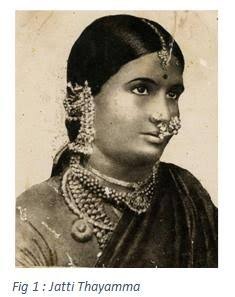
Finally, this entire operation of visual superimposition is definitively refuted when compared to the authentic and certified archival portrait of Jatti Thayamma. The facial features, the actual bone structure, and the real physiognomy of the maestro show a total and striking discrepancy against the aestheticized and painted idealizations of the commercial postcards used to manufacture her alleged Brahmin identity.
III. The Double-Standard Reliability of Colonial Sources
From the perspective of methodological critique, the treatment reserved for colonial-era archives within this narrative exposes a blatant and unsustainable confirmation bias, resulting in a “double-standard” use of sources.
When a caption appended by a 19th-century British photographer happens to support the researcher’s thesis—as is the case with the commercial label “Brahman Lady” on Coleman’s postcard—the colonial source is instantly elevated to the rank of anthropological dogma and incontestable scientific proof of the model’s lineage. This deliberately ignores the fact that colonial-era photography operated within a tourist and commercial print market, cataloging subjects based on visual stereotypes, the opulence of attire, or the richness of jewelry, without conducting any real genealogical or caste investigation.
Conversely, as already highlighted regarding the 1910 photograph, the exact moment a colonial archive produces a chronological datum that contradicts the researcher’s theory, its authority is abruptly revoked. The British cataloging is suddenly downgraded to a product of approximation and ignorance. This opportunistic approach strips historical research of all neutral rigor: the document ceases to be an instrument of inquiry and mutates into a mere pretext to validate a pre-existing ideological agenda.
IV. Sanskritization vs. Absorption: The Sociological Distortion of the Jatti Caste
To formally justify the label of “Brahmin woman” applied to Jatti Thayamma, revisionist historiography engages in a sociological scramble, attempting to redefine the dancer’s community of birth. Citing classic texts of local anthropology (such as The Mysore Tribes and Castes), it highlights how the Jatti community—historically associated with court wrestlers, bodyguards, and martial entertainers of the Maharaja of Mysore—practiced complex domestic rituals, including the sacred thread ceremony (Upanayana). From this premise, the narrative draws the arbitrary conclusion that the Jatti were “by tradition Brahmins” or had been literally “absorbed” by them.
This thesis represents a severe distortion of the social mechanisms of pre-modern and colonial India. The phenomenon described is not a “caste absorption” (a dynamic that was ritually impossible and thoroughly prevented by the marital endogamy of the era), but rather a textbook process of Sanskritization, as theorized by the sociologist M.N. Srinivas. Through Sanskritization, an intermediate or martial community that had accumulated significant economic power and close proximity to the sovereign adopted the dress codes, vegetarian diet, rituals, and aesthetics of the priestly castes in order to elevate their overall social prestige.
Adopting the lifestyle, ritual purity, or elegance of Brahmins did not transform the Jatti into Brahmins. No member of the priestly caste would have ever considered a court wrestler as a kinsman or a ritual equal. Jatti Thayamma belonged, in every respect, to the Jatti community; the puritanical and modern haste to “cleanse” and “Brahminize” her ultimately and paradoxically erases the extraordinary and fascinating complexity of a martial caste capable of becoming the custodian of a highly refined choreographic and cultural tradition.
V. Conclusion: Post-Truth in the History of Indian Dance
In the final analysis, the deconstruction of the narrative attempting to turn Jatti Thayamma into a “Brahmin dancer” demonstrates that this theory holds no water. It fails to withstand the cross-verification of archival dates, crumbles before the evidence of facial features in the genuine photographic documentation, and fails to correctly apply the most basic concepts of the sociology of Indian castes.
This genre of essay writing does not constitute an objective historical study, but rather functions as an operation of cultural whitewashing and historiographical post-truth. The ideological urgency to legitimize the current ownership of Bharatanatyam by social élites drives the manipulation of the past. It seeks to prove that the art suffered no trauma, censorship, or appropriation, but was instead “already pure” and firmly in the hands of the upper classes since its 19th-century origins.
Restoring Jatti Thayamma to her true identity as a master of the Jatti caste, inextricably linked to the court life of Mysore, is not merely about defending the rigor of historical and archival methodology. Above all, it means doing justice to the memory of the dance and to all those communities who, outside of Brahmin hegemony, created, protected, and passed down the performance heritage of South India before modern history decided to drape it in the artificial veil of ideological distortion.

